|
|
 |
 |
| |
|
|
|

|
 The Perfect Bet: How Science and Maths are Taking the Luck Out of
Gambling The Perfect Bet: How Science and Maths are Taking the Luck Out of
Gambling
by Adam Kucharski
A wild ride through the history, psychology, mathematics, and technology of
gaming - a remarkable look behind the curtain of what most people think is intuitive, but isn't
With an entertaining writing style, Adam Kucharski
guides us through the history and state of the art of The Perfect Bet showing us how mathematics and computers are used to come up with optimal ways to gamble,
play games, bluff, and invest our money. Extremely well-written and carefully researched.
Those who are mathematically educated (or indeed simply a fan
of pop-science books) will delight at historical mentions of the likes of Poincare, Fermat and others, whose probabilistic ponderings resulted in the evolution
of game theory. There is a sprinkling of modern Michael Lewis type characters - mathematical PhDs with a love of loot. Anecdotal stories are in abundance of
those who have tried to win at roulette, poker, draughts, scratch cards, chess and landing on the world of modern day online betting. We are exposed to the
origins of the Monte Carlo method and Markov chain and even high frequency trading gets a mention.
Paperback
- Profile Books; Main edition (5 May 2016) 288 pages £3.29
Kindle Profile Books; Main edition (5 May 2016) 288 pages £3.79
 Cutting the Wire: Gaming Prohibition and the Internet Cutting the Wire: Gaming Prohibition and the Internet
by David G. Schwartz
The story of the Wire Act and how Robert Kennedy's crusade against the Mob is creating a new generation of Internet gaming
outlaws. Gambling has been part of American life since long before the existence of the nation, but Americans have always been ambivalent about it. What David
Schwartz calls the "pell-mell history of legal gaming in the United States" is a testament to our paradoxical desire both to gamble and to control gambling. It
is in this context that Schwartz examines the history of the Wire Act, passed in 1961 as part of Attorney General Robert F. Kennedy's crusade against organized
crime and given new life in recent efforts to control Internet gambling.
"Cutting the Wire" presents the story of how this law first developed, how it
helped fight a war against organized crime, and how it is being used today. The Wire Act achieved new significance with the development of the Internet in the
early 1990s and the growing popularity of online wagering through offshore facilities. The United States government has invoked the Wire Act in a vain effort
to control gambling within its borders, at a time when online sports betting is soaring in popularity. By placing the Wire Act into the larger context of
Americans' continuing ambivalence about gambling, Schwartz has produced a provocative, deeply informed analysis of a national habit and the vexing predicaments
that derive from it. In America today, 48 of 50 states currently permit some kind of legal gambling. Schwartz's historical unraveling of the Wire Act exposes
the illogic of an outdated law intended to stifle organized crime being used to set national policy on Internet gaming. "Cutting the Wire" carefully dissects
two centuries of American attempts to balance public interest with the technology of gambling.
Paperback -
University of Nevada Press (1 Sept. 2005) 296 pages £9.89
Kindle - University of Nevada Press (1 Sept. 2005) 296 pages
£21.80
 Fortune's Formula: The Untold Story of the Scientific Betting System That Beat the Casinos and Wall
Street Fortune's Formula: The Untold Story of the Scientific Betting System That Beat the Casinos and Wall
Street
by William Poundstone
This is an excellent book about the discovery of the Kelly formula that is
unknown outside gambling. This story has three protagonists. Two of them were scientists working at Bell Labs: Claude Shannon, a genius polymath who developed
information theory; and John Kelly, a maverick genius, who is directly responsible for the development of Kelly's formula. The third one is a brilliant MIT
mathematician, Ed Thorp.
As the author states, Ed Thorp's genius consists in "...his continuous ability to discover new market inefficiencies ... as
old ones played out." Ed Thorp closed this second fund in 2002. He is now independently exploring inefficiencies in gambling.
Claude Shannon amassed
large wealth by recording one of the best investment records. His performance had little to do with Kelly's formula. Between 1966 and 1986, his record beat
even Warren Buffet (28% to 27% respectively). Shannon strategy was similar to Buffet. Both their stock portfolios were concentrated, and held for the long
term. Shannon achieved his record by holding mainly three stocks (Teledyne, Motorola, and HP). The difference between the two was that Shannon invested in
technology because he understood it well, while Buffet did not.
John Kelly was a chain smoking, gun collecting brilliant physicist. He died young at 41
of an aneurysm. He worked closely with Shannon at Bell Labs. Besides being a charismatic character the author does not write much about his life compared to
the other two.
Paperback - 386 pages Non Basic Stock Line (19 Sept. 2006) £13.96
Hardback - 400 pages Hill & Wang (14 Sept. 2005) £19.88
 Against the Gods: The Remarkable Story of Risk Against the Gods: The Remarkable Story of Risk
by Peter L. Bernstein
Bernstein has managed to take a subject which at first sight seems intensely boring, and has made it fascinating. Whether
or not you have any interest in Risk, Statistics or Econimics, you owe it to yourself to read this book. It is quite simply a "Ripping Yarn". Its greatness
lies in Bernstein's ability to tell the story in an accessible manner, without dumbing down the essential facts. Let me say it again: Read this book because it
is a fascinating and well written story. The fact you will know a lot more about Risk at the end of it is an incidental, but very welcome, extra.
Paperback - 400 pages (9 October, 1998) £11.33
Kindle - 383 pages Wiley; 1 edition (21 April 2008) £10.76

Gambling: A Story of Triumph and Disaster
by Mike
Atherton
In Paris on the first Sunday in October, the crowds gathered for Prix de l'Arc de Triomphe at Longchamp
were also subject to another spectacle. About 10,000 Japanese spectators turned up to cheer on their wonder horse, Deep Impact. What followed was betting on a
scale rarely seen in racing as the Japanese backed their hero until they could back no more. By the time Deep Impact went off at odds of 1-10, those who had
backed him were losing money and the market was impossibly skewed. The horse lost, the once-prized tickets hit the ground and those left cheering were the few
who had backed Andre Fabre's Rail Link at a ridiculous 24-1.
The story of Deep Impact would, no doubt, have raised a rueful smile from Mike Atherton,
whose impeccably researched and entertaining book covers such tales. This is the story of men and women who have made a packet one day and lost it the next. We
meet men such as Ray Joseph, who spends his days sitting in his impersonal house flanked by computers, pro-poker players, old and young, and horse fanatics. We
meet those for whom gambling is a mathematical certainty and those brought to the brink by addiction.
Throughout, Atherton records the highs and lows
with a clear eye. A small-scale gambler himself, he neither condemns nor condones but, instead, explores the history of Britain's relationship with gambling,
from 17th-century earls placing lunatic bets to decadent games of chemin de fer in John Aspinall's private clubs in the Sixties and the more clinical internet
betting of today. He is adept at capturing the adrenaline rush that accompanies the thrill of winning, yet this is no paean to the beauty of betting. Atherton
notes that Britain has as many as 400,000 gambling addicts and is equally concerned about the psychology, the possible effects of proposed supercasino
legislation and the links with match-fixing.
Thought-provoking, witty and elegantly written, Gambling, is the essential companion for those who like a
flutter, seasoned gamblers and anyone who wants to understand one of those most pressing issues in modern Britain.
Mike Atherton was educated at
Manchester Grammar School and Cambridge University. He was made captain of the England cricket team in 1993 at the age of 25. He is the author of the acclaimed
autobiography Opening Up:
Hardcover - 352 pages (7 Sep 2006)  £11.39 £11.39
Paperback - 352 pages (6 Sep 2007) £8.99
 High Stakes: How I Blew 14 Million Pounds High Stakes: How I Blew 14 Million Pounds
by Nigel Goldman
High Stakes was written while author Nigel Goldman was in prison. It is a book about greed, the chances and opportunities afforded to him in
life, and about how seeking the ultimate win led him to experience extremes of lifestyle.The book takes us on a roller coaster ride, beginning with his
wheeling and dealing at public school and the formation of his first business, which subsequently folded due to his compulsive gambling. After escaping the UK
for America in an attempt to evade creditors, there followed three years of hectic trading on the New York Commodity Exchange, which culminated in a windfall
profit.
Following this fortuitous upturn in finances, Goldman then returned to the UK and founded a new company but soon became involved in a highly
publicised multi-million pound VAT fraud trial. Although he was dramatically cleared of this crime, he was soon to spend a short spell in prison for an
unrelated fraud misdemeanour. Upon his release, Goldman set up yet another business venture that brought with it the luxuries of expensive cars, exotic travel,
flamboyancy and lucrative racehorse ownership. After drilling oil wells dry on and off for over 15 years, the sum of Goldman's wealth stood at around 14
million.
Goldman then goes on to detail how he managed to offload this vast sum in a very short period of time only to land back in prison, this time
for a more substantial period, before finally deciding to go straight and start a new life as a bookmaker on the Costa Del Sol.
Paperback - 272 pages Mainstream Publishing (30 Sept. 2004)
£3.75
Kindle - 272 pages Mainstream Publishing (21 Dec. 2012)
£3.99
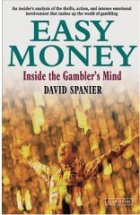 Easy Money: Inside the Gambler's Mind Easy Money: Inside the Gambler's Mind
by David Spanier
David Spanier
studies the psychological motivation of gamblers, those who beat the system and those beaten by it, portraying the personalities and legends of the gambling
world of the time. Spanier ranges widely over his subject, considering the motivations of gamesters, stressing the physical sensations they experience, the
percentages and chances, heuristic principles, the differences in European and American gambling, and the criminal element in U.S. gaming, but concentrates
primarily on the human side of gambling rather than the mathematical or theoretical.
While he is comfortable discussing Freud's analysis of the
compulsive gambler, his real emphasis is on the individuals: the mathematician who devised a way to beat the house advantage at blackjack; the London
man-about-town who ran games for the upper class; the cleric who founded the British Gamblers Anonymous; the physician who established a "gamblers' hospital"
in Brecksville, Ohio. This is an insider's analysis of the thrills, action, and intense emotional involvement that makes up the world of gambling.
Hardcover - 240 pages High Stakes Publishing; New edition (4 May 2006) £9.99
No
Kindle -
 Bad Bet by Timothy L. O'Brien Bad Bet by Timothy L. O'Brien
Subtitled - The Inside Story of the Glamour, Glitz, and Danger
of America's Gambling Industry
There is tons of research here by a journalist clearly in command of his craft. There is a clear anti-gambling view when
looking at the big corporations that run this business, but O'Brien truly appreciates the legends and culture of the gambling world and gives them their due.
After all, big corporations have their own wallets in mind in all of this. Anyway, this is a fun, breezy, informative book and anyone betting on sports or into
casinos should read it.
Hardcover - 339 pages Times Books; First Edition edition (1 Aug. 1998)
£3.98
No Kindle - |
|
|
 The Gambler's Guide to the World The Gambler's Guide to the World
by Jesse May
Subtitled - The Insider Scoop from a Professional Player on Finding the Action, Beating the Odds, and Living It Up Around the
Globe.
Jesse May, an intrepid gambler, experienced poker analyst, and critically acclaimed writer, has traveled across the country and around the world
in search of the hottest gambling action. From sports betting in Costa Rica to high-stakes Vegas poker, from caviar and vodka in Moscow to funnel cakes and
submarine sandwiches in Atlantic City, May has tried his hand and his luck at gambling and indulged in the good life across the globe. In The Gambler's Guide
to the World, he blends an insightful travel guide with a lively travel narrative to create a totally unique guidebook to the choicest sites in the world.
Paperback - 320 pages Broadway Books (1 Dec. 2000) £1.03
Kindle - 320 pages Broadway Books (17 April 2013) £3.49
 The Man With the $100,000 Breasts : And Other Gambling Stories by Michael Konik The Man With the $100,000 Breasts : And Other Gambling Stories by Michael Konik

Michael Konik takes a topic that is usually
covered in a bland, how-to kind of way and delivers thoughtful, entertaining stories that seem like they're right out of the movies. And they're all true! My
personal favourites are Chapter Nine, "Go Greyhound!" which may be the funniest story ever written about gambling, and the book's final chapter, "The Hand
You're Dealt," which may be the single finest essay on what it really means to "get lucky" in a casino and in life.
Paperback - 256 pages (January 2000) £6.69
 Gambling Gambling
by Paul Lamford
A good all round look at Gambling from horse
racing to poker and bingo. Advice on how to calculate odds and increase your skill. Full of background information and tips about the world of
gambling.
Hardback - 192 pages ( 3 April, 2000) £0.49
 The Quotable Gambler by Paul Lyons (Editor) The Quotable Gambler by Paul Lyons (Editor)
This book is a Compendium of
quotes
"It is not as destructive as war or as boring as pornography. It is not as immoral as business or as suicidal as
watching television. And the percentages are better than religion"--Mario Puzo
"Horse sense is a good judgment that keeps horses from betting on people.
"God not only plays dice. He also sometimes throws the dice where they cannot be seen." -Stephen Hawking
Hardcover
- 326 pages (October 1999) £2.69
 The Big Con by David Maurer The Big Con by David Maurer
"A term such as
cackle-bladder or shut-out cannot be properly described without giving a full account of its use, and such an account cannot be illustrated by stick figures".
Thus The Big Con is filled with richly detailed anecdotes populated by characters with names like Devil's Island Eddie, the Honey Grove Kid, the Hashhouse Kid,
and Limehouse Chappie ("distinguished British con man working both sides of the Atlantic and the steamship lines between, all with equal ease"). David Maurer
spent years talking to con men about their profession, learning about each and every step of the three big cons (the wire, the rag, and the payoff). From
putting the mark up to putting in the fix, Maurer guides readers through the fleecing--pretty soon you'll be forgetting the book's scientific value and reading
for sheer entertainment. (A cackle-bladder, by the way, is a fake murder used to scare the victim off after his money's been taken. As for the shut-out, well,
that you'll have to learn on your own.).
Paperback - 291 pages ( 1 June, 2000) £5.59
|
|
| |
|
|
|
| |
| |
|
|
|


 Main
Menu
Main
Menu

