|
To Begin With
Casino Stud Poker (CSP) is not real
poker at all. It is an almost carbon copy of the American casino game,
Carribean Stud Poker. In both games the object for the player is to have a
better hand than the dealer at the showdown. Hands are rated in the
strict poker sense.
The Play
You sit down at a
CSP table and place your cash money on the
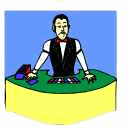 table in a way that lets the dealer know you want to
play. The dealer will exchange your money for cash chips with which you
can start betting. There are table limits that mean there is a minimum bet and
a maximum bet for your ante. table in a way that lets the dealer know you want to
play. The dealer will exchange your money for cash chips with which you
can start betting. There are table limits that mean there is a minimum bet and
a maximum bet for your ante.
Before the deal
begins, players must make an initial ante bet inorder to be dealt cards.
This is placed on a small circle in front of the player and marked for that
purpose. When the antes are placed the dealer deals one card to each
player's box and then to themselves, and does this five times. All cards
are face down except the fifth card to the dealer. This is left face up for all
to see. When the deal is finished, players pick up their cards and decide
whether they want to play their hand or pass it.
Key Rules
There are two things to know about this
game that come into force right at this point in the play.
1) In order to 'play' their hand, the player must make another
bet of exactly twice their ante bet. This is called a raise.
Choosing not to raise is choosing to pass, and results in the loss of
the ante.
2) The dealer will only compete with the player's hand
if their hand has a value of at least, Ace-King-x-x-x ( x is any card ).
This is called qualifying.
The rules of the
game mean that the betting levels are fixed and that players who raise
with a hand, will only be paid out (at even-money) on their ante bet if
the dealer does not qualify. So if you have a strong hand, like
10-10-10-x-x, you will not only be restricted to raising twice your
ante but if the dealer does not qualify, you will only be paid
out on your ante bet. The raise is returned.
When all players
have made their decision, the dealer exposes all their own cards to see what
the value of their hand is. If they don't qualify then all ante
bets are paid. If they do, then the dealer compares their hand with each
individual player hand. Winning player hands are paid out on both ante
and raise bets, losing player hands forfeit all bets.
|
Bonus Payouts |
|
| |
Player Hand |
Odds |
| |
Straight Flush |
50-1 |
| |
Four of a kind |
20-1 |
| |
Full House |
8-1 |
| |
Flush |
6-1 |
| |
Straight |
4-1 |
| |
Three of a kind |
3-1 |
| |
Two Pair |
2-1 |
| |
One Pair |
Evens |
| |
Ace King high |
Evens |
|
|
Bonus Payouts
Winning player hands are paid according
to the bonus payout scheme in the table.
What this means is
that if you beat the dealer's hand with your own hand of Two
Pair, then your raise bet will be paid at odds of 2-1 whilst
your ante bet gets paid at evens. Thus you will win a total of
five units. [Raise bet = 2 units, paid at 2-1 returns 4 units.
Ante bet = 1 unit, paid at Evens returns 1 unit. So
4+1=5]
Playing Conditions
It is a general rule that
players should not disclose their hands to each other during the play. So don't
show your cards to other people expecting them to do the same in return. Whilst
this will annoy the house if you do it, there is no practical benefit
from it. In fact The Good Gambling Guide recommends you do not do it because
seeing other peoples cards may induce you to play a hand that you would
otherwise pass! |



 Main Menu